An escrow shortage can raise your total mortgage payment even when the loan has a fixed interest rate. The first task is to find which part of the bill changed. Principal and interest, taxes, insurance, shortage repayment and fees are different lines with different explanations.
This guide shows an itemized example and a checklist for discussing the change with your servicer, the company collecting the payment. It does not assume an error occurred or that every homeowner has the same repayment options.
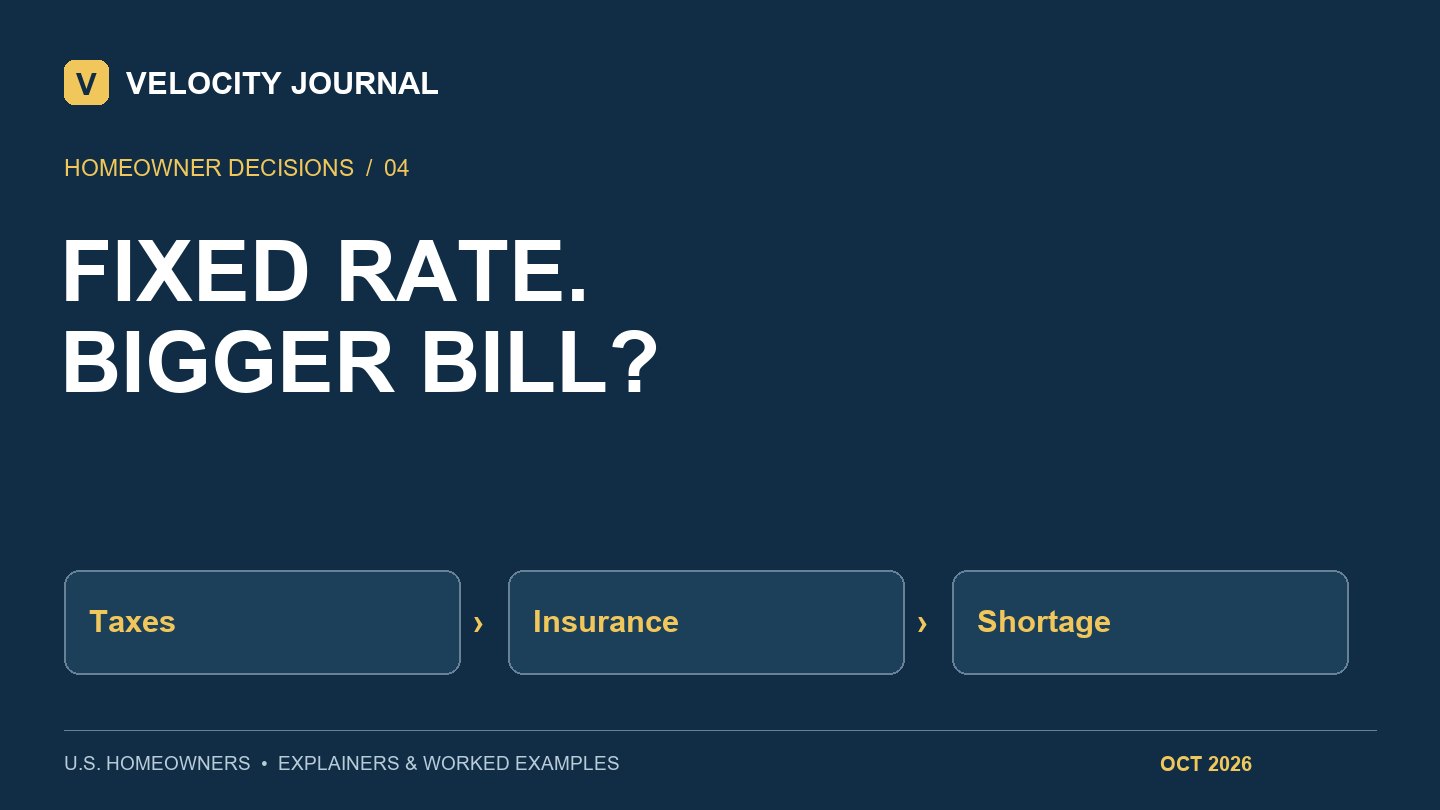
Fixed rate does not mean every housing cost is fixed
The CFPB explains that escrow accounts collect money for property-related costs such as property taxes and homeowners insurance. When those bills change, the escrow portion of the monthly payment can change too.
That is separate from the note rate. With a standard fully amortizing fixed-rate mortgage, the scheduled principal-and-interest payment can remain unchanged while the amount collected for taxes and insurance increases. A news story about mortgage rates will not explain that increase by itself.
First confirm the type of loan you actually have. An adjustable-rate loan, a temporary buydown or another payment feature can produce a different explanation. The CFPB’s payment-change guide lists several possibilities and recommends checking the itemized statement.
Separate future escrow costs from a past shortage
A future budget increase and a shortage are not the same calculation. One looks at what the account needs for upcoming bills. The other addresses a shortfall identified in the analysis. Your statement may include both, which can make the payment jump feel larger than the change in annual insurance alone.
Read the annual escrow analysis, not just the new payment notice. Identify the projected bills, the amounts already paid, the balance calculation and any repayment schedule. Ask the servicer to explain anything you cannot match to the documents.
| Component | Previous monthly amount | New monthly amount | Change |
|---|---|---|---|
| Principal and interest | $2,000 | $2,000 | $0 |
| Property-tax budget | $300 | $350 | +$50 |
| Insurance budget | $150 | $200 | +$50 |
| Shortage repayment | $0 | $100 | +$100 |
| Total collected | $2,450 | $2,650 | +$200 |
Here, the old tax-and-insurance budget was $5,400 a year. The new budget is $6,600, a $1,200 annual difference, or $100 a month. Separately, assume the analysis calls for repaying a $1,200 shortage in 12 monthly installments: another $100 a month.
This simplified example assumes no mortgage insurance, association dues or other fees and leaves out escrow cushion details. The 12-month schedule is an illustration, not a statement that every borrower can choose the same terms. Federal rules, the analysis and the applicable agreement govern.
Can paying the shortage fix the whole increase?
Paying a past shortfall does not, by itself, lower the cost of future tax and insurance bills. In the example, even if the $100 shortage installment ends, the ongoing collection for projected bills is still $550 a month instead of $450, assuming those projections remain unchanged.
Before considering a lump sum, ask what is allowed, how the payment would be applied and what the revised monthly amount would be. Do not treat a past shortage and a future budget increase as one interchangeable charge.
The CFPB’s escrow-account regulation sets out analysis and shortage rules. Your situation may depend on the shortage size, payment status and other facts. Ask for the explanation in writing instead of relying on a generic online example.
What should you check in the documents?
Gather the latest statement, the annual escrow analysis, the property-tax bill and insurance renewal. Compare dates, amounts and any changes to coverage or assessments. Keep the documents private; you do not need to post personal financial records to understand the categories.
- Write down the old and new principal-and-interest amounts.
- List projected property taxes and insurance separately.
- Identify any shortage, deficiency, fee or other adjustment.
- Check which bills the servicer has already paid.
- Ask how the new monthly total was calculated.
- Request the available next steps and their effect on future payments.
For example, a renewal notice may show a higher premium that matches the analysis. That points to a real expense change, though the budget calculation still deserves review. In a different hypothetical case, the analysis may use an amount you cannot reconcile with the bill. That is a question to document, not proof of an intentional overcharge.
How to ask the servicer for a clear explanation
Use a short request focused on the calculation. Note the date, the person you spoke with and the explanation given. If you believe there is an error, the CFPB payment-change guide explains the next step of a written notice and the need to use the designated address.
My total monthly payment changed from ___ to ___.
Please separate principal and interest, projected taxes,
projected insurance, shortage repayment and other charges.
Which amounts are temporary, and when do they end?
Please explain the bills and balance used in the analysis.
What options apply to my account, and what would each do
to the required monthly payment?
Continue handling required payments according to the loan terms while you seek an explanation. Do not simply send the old amount because a charge is under discussion. If affordability is the issue, raise that with the servicer rather than assuming a calculator can resolve it.
Update the payoff plan after the bill is clear
An escrow increase can reduce the cash available for extra principal payments. Recalculate with a sustainable amount. A new payoff estimate should reflect actual expenses, not the extra payment you hoped to make before the increase.
If you are also evaluating a new loan, use the refinance costs and term comparison. For the broader context, return to the October mortgage news and decision guide. The existing planning checklist can help organize inputs. This article is educational and does not determine the terms or rights on a particular account.

About the Author Michael
MBA in Quantitative Finance – Wharton School (University of Pennsylvania). "I built products for the banks. Now, I dismantle them for you." Michael Schmidt is a veteran financial strategist and the architect of the Mortgage Killer Method. With over 15 years of experience inside America's largest lending institutions, Michael worked behind closed doors structuring mortgage backed-securities. He saw firsthand how the "30-year fixed" system is engineered to prioritize institutional profit over homeowner equity. In 2015, Michael walked away from Wall Street with a clear objective: to reverse-engineer banking mathematics for the average American family. He specializes in aggressive principal reduction strategies, using HELOCs to cut amortization timelines by decades. Michael brings German precision to debt management. His frameworks are not theories—they are mathematical certainties. To date, he has helped over 1,500 families reclaim an estimated $50 million in interest from the banking system. Expertise: Strategic Debt Elimination, Amortization Mechanics, Cash Flow Optimization. Background: Former VP of Lending Strategies.